Supermarket price comparison in the UK: who runs the apps and trackers, and where their data comes from
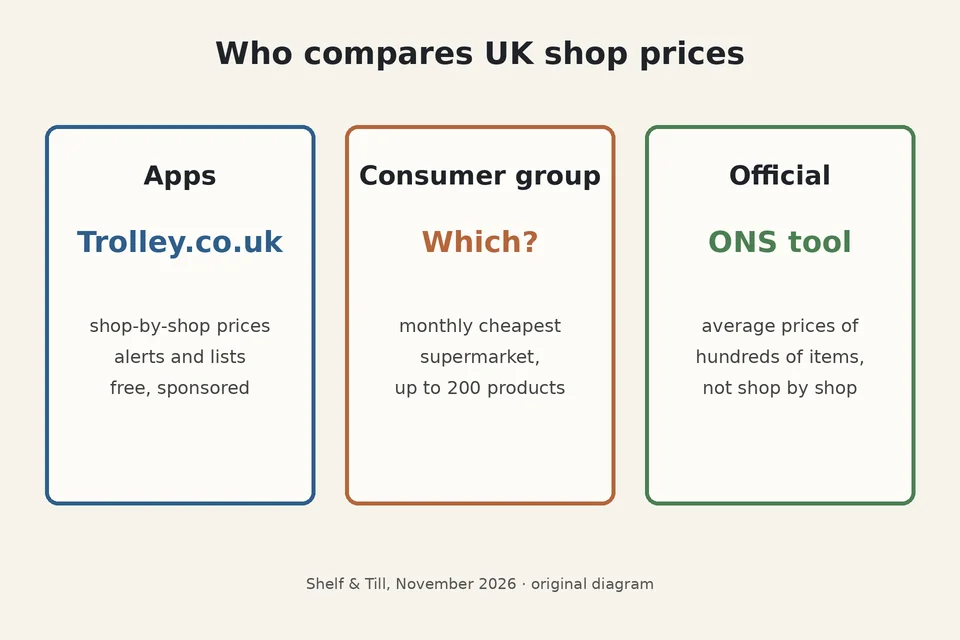
"Which supermarket is cheapest?" sounds like a question with one answer. In practice the UK has several kinds of price comparison, each built on different data and each answering a slightly different question: is this tin of beans cheaper at Asda or Tesco today, which chain was cheapest for a typical basket last month, and how much has the average price of bread risen in a year. This guide sets out who runs the main ones, where their prices come from and how to use them together.
Three kinds of comparison
- Product-by-product apps and websites show the current price of a given item at several shops. Useful before a shop, or to set an alert on things you buy often.
- Basket league tables compare the total cost of a fixed list of products across chains over a month. Useful to choose where to do a weekly shop.
- Official average prices track what an item costs across the country over time. Useful to understand inflation, not to choose a shop.
Behind all three sit companies that collect shelf and online prices for a living, and whose data is often resold to retailers, brands and publishers.
Who runs them
Trolley.co.uk: shop-by-shop prices
Trolley.co.uk is a free website and app that compares the prices of individual grocery and household products across UK supermarkets and some other shops, and lets users build lists and get alerts when a price changes or an offer starts. According to its about page, it is "powered by sponsors and will always be free to use"; the same page states that it has helped "3m+ families compare groceries", a figure the company reports itself.
Good for: checking a specific product before you buy, and watching items you buy every week. Watch for: prices on comparison sites come from the shops' online listings and may differ in store, by region or for small branches; loyalty prices need the card or app.
Which?: the monthly cheapest supermarket
The consumer organisation Which? publishes a monthly supermarket price comparison of eight chains: Aldi, Asda, Lidl, Morrisons, Ocado, Sainsbury's, Tesco and Waitrose. It explains that it tracks the prices of up to 200 branded and own-label products every day over a month, that its data is supplied by an independent price comparison company, and that fieldworkers gather prices for stores without online prices. Loyalty and non-member prices are reported separately. In October 2026 Aldi came out cheapest, at £154.34 for its list of 87 items, ahead of Lidl with Lidl Plus at £157.17.
Good for: deciding where to do a regular shop, and seeing whether a loyalty scheme changes the ranking. Watch for: the result depends on the list. Which? also publishes a separate tracker for branded groceries, which leaves out Aldi and Lidl because they do not stock the same range of branded goods.
The ONS shopping prices comparison tool: official averages
The Office for National Statistics runs a shopping prices comparison tool, launched on 3 May 2023, that shows how the average prices of hundreds of shopping items are changing. The figures come from the prices collected for consumer price inflation. The ONS notes that from March 2025 the way it aggregates prices changed, and that from March 2026 average prices for many food, drink and tobacco products incorporate scanner data alongside locally collected prices.
Good for: checking whether a price rise you noticed is general, and putting a shop's prices in context. Watch for: it does not say which shop is cheaper; it is an average across retailers. Our article on shrinkflation and what the ONS counted shows how the same statisticians handle pack sizes.
The data collectors behind the scenes
Comparisons need prices collected at scale, often every day, online and in store. Specialist retail research firms do this work. One of them, Assosia, describes itself as a global retail research and quality assurance company, and its home page reports "2900000 lines of data collected online today" and "175000 lines of data collected in-store this week". Firms like this sell price and promotion tracking to retailers, brands and public bodies; consumer-facing comparisons often rely on similar data, though they do not always name the supplier.
How to use them together
- Choose a shop with a basket comparison, ideally one that reports loyalty and non-member prices separately, then stick with it for a few weeks rather than chasing single offers.
- Check single items with an app for the products that matter most in your budget: coffee, nappies, washing powder, the things you buy in bulk.
- Compare unit prices on the shelf, not pack prices. Our guide to reading a unit price shows how in five seconds.
- Treat member prices with care. They are usually real discounts on that shop's own normal price, as the regulator found; whether they beat another shop's regular price is a separate question. Our piece on whether loyalty prices are real savings sets out the figures.
- Use official averages for perspective: if everything you buy seems dearer, the ONS tool tells you whether that is your shop or the market.
What no comparison can tell you
Every comparison makes choices: which products, which sizes, which shops, which day, whether to include offers. A shop can be cheapest on one list and not on another. Prices in small convenience formats are often higher than in the same chain's large stores, and online prices may not match the shelf. The most reliable comparison remains your own: the receipt for the shop you actually do, kept for a month and checked against an alternative.
Shelf & Till has no commercial relationship with the services named here and earns nothing from them. Information checked on their own websites on 26 November 2026. Mentioned here and want a correction or removal? Contact us.
Sources
- Trolley.co.uk, "About", consulted 26 November 2026.
- Which?, "Which is the UK's cheapest supermarket?", October 2026 results, consulted 26 November 2026.
- Office for National Statistics, "Shopping prices comparison tool", consulted 26 November 2026.
- Assosia, home page, consulted 26 November 2026.
Free to reuse with a link to this page.
 Deals & promotions
Are supermarket loyalty prices real savings?
92% were genuine savings, 61 of 429 were cheaper elsewhere: the CMA's figures, read carefully.
 Labels & units
How to read a unit price
The small number on the shelf label, its five traps, and the rules in force since April 2026.
 Prices over time
Shrinkflation: what the ONS counted
2,529 price quotes, 206 products: what official statisticians found about shrinking packs.