The meal deal: a short history of the British lunch bundle, from Boots in 1999 to the 2025 promotion rules
A main, a snack and a drink for one fixed price: few shopping habits are as British as the meal deal. It has its own online arguments about which crisps count, and its own place in the household budget of millions of office workers and students. Yet the format is younger than most people think. This is a short history of how a chemist's sandwich counter became a national institution, and of the rules and prices that shape it today.
Before the deal: the packaged sandwich
For most of the twentieth century, British workers did not buy lunch in a shop. They ate in a staff canteen, went home or brought something from home. The packaged sandwich, sealed in a plastic wedge and sold from a chiller, only became an everyday product in the 1980s, when high-street chains began to treat it as a manufactured food with consistent recipes and shelf lives.
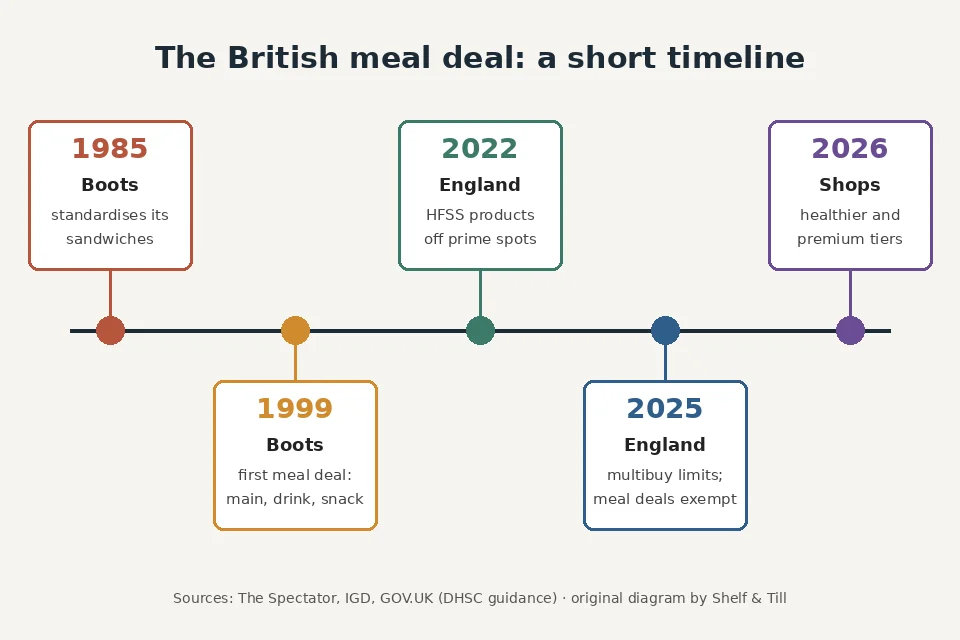
A column in The Spectator sums up the scale of the change: in 1980, 70 per cent of workers ate lunch in a canteen or went home. The same piece credits Boots, which in 1985 standardised factory production so that every store carried the same sandwich, with creating the first truly national lunch offer. A chemist was an unlikely pioneer, but Boots had what the format needed: hundreds of high-street shops near offices, long opening hours and customers who were already used to quick, practical purchases.
1999: the first meal deal
The bundle itself came later. According to the same Spectator column, Boots introduced the first meal deal in 1999: a sandwich, drink and snack for £2.50. The grocery research body IGD gives the same year, noting that Boots invented the meal deal in 1999 and that the format has since become a fixture across UK retail. Some popular accounts, including the Wikipedia article on meal deals, blur the two dates; the most precise sources separate the sandwich production change of the mid-1980s from the bundle launched at the end of the 1990s.
The idea was simple and hard to copy only in its logistics. A fixed price removes the mental arithmetic from a rushed purchase; the drink and snack, with higher margins than the sandwich, make the bundle profitable even at a discount; and the "pick one from each shelf" rule pushes customers through the store.
The copycats
Over the following years, the supermarkets' convenience stores, bakery chains such as Greggs and eventually coffee and fast-food chains adopted the format. Each added its own twist: hot food at bakeries, sushi and salad boxes in supermarkets, premium tiers with more expensive mains, breakfast versions. Even brands that once promised never to sell a bundle ended up offering one, as the Spectator piece notes of Pret and McDonald's.
The evening equivalent appeared as the "dine in for two": a main, a side, a dessert and sometimes a bottle of wine for a set price, a format closely associated with Marks & Spencer. In 2019 it even reached the tax courts, when a tribunal had to decide whether the bottle of wine "included" in such a deal was really free for duty purposes; it ruled that it was not.
Two prices for one deal: the loyalty-card split
The biggest change of the 2020s was not the food but the price tag. The large supermarkets started to show two prices for the same meal deal: a lower one for loyalty-card holders and a higher one for everyone else. When Tesco raised its prices in 2025, the consumer group Which? reported that its standard meal deal went from £3.60 to £3.85 with a Clubcard, and from £4 to £4.25 without, and that Tesco said around 80% of its customers use a Clubcard when buying a lunchtime meal deal.
This split turned the meal deal into one of the most visible examples of "member pricing", the practice examined by the Competition and Markets Authority and discussed in our article on whether loyalty prices are real savings. Prices change without notice and differ between store formats, so we do not publish a current price list here; the comparison tools described in our guide to supermarket price comparison are a better place to check today's figures.
The 2025 promotion rules: why meal deals survived
From 2022, England began to restrict the promotion of foods high in fat, sugar or salt (HFSS). The Department of Health and Social Care's implementation guidance sets out the two stages: the restriction by location came into force on 1 October 2022, and the restriction of volume price promotions such as "buy one get one free" on 1 October 2025.
Many shoppers expected the second stage to end the meal deal, since crisps, chocolate and sugary drinks are often part of it. It did not. The same guidance explains that offers commonly referred to as "meal deals" or "dine in for 2", where foods are promoted as intended to be eaten together, are out of scope of the volume price restrictions. The reasoning is that a meal deal reduces the cost of a single meal rather than encouraging people to stockpile. Wales is taking its own route: in 2023 the Welsh Government announced plans that would also cover meal deals containing less healthy foods, a proposal that retailers criticised.
Where the meal deal is going
Two trends stand out in 2026. The first is health: retailers are adding lower-calorie and higher-protein options. Boots, the format's inventor, launched a new healthy meal deal range on 27 May 2026, a line of 15 products aimed in part at people taking weight-loss medicines. The second is tiering: standard, premium and sometimes "extra" deals at different price points, which let chains raise the average spend while keeping a headline entry price.
Whatever the price, the arithmetic behind a meal deal stays the same: it is only a bargain if you would have bought all three items anyway. Comparing the deal with the cost of the items you actually want, using the shelf-edge unit prices explained in our guide to unit prices, is still the quickest way to know whether the bundle is saving you money.
Sources
- The Spectator, We don't need a breakfast meal deal.
- IGD, How UK meal deals are reinventing the lunch run.
- Which?, Tesco hikes meal deal prices – is it still good value for lunch?, 22 August 2025.
- Department of Health and Social Care, Restricting promotions of products high in fat, sugar or salt by location and by volume price: implementation guidance, GOV.UK.
- Boots UK newsroom, 'Boost by Boots': new healthy meal deal choices, 27 May 2026.
- Wikipedia, Meal deal.
 Deals & promotions
Are supermarket loyalty prices real savings?
92% were genuine savings, 61 of 429 were cheaper elsewhere: the CMA's figures, read carefully.
 Deals & promotions
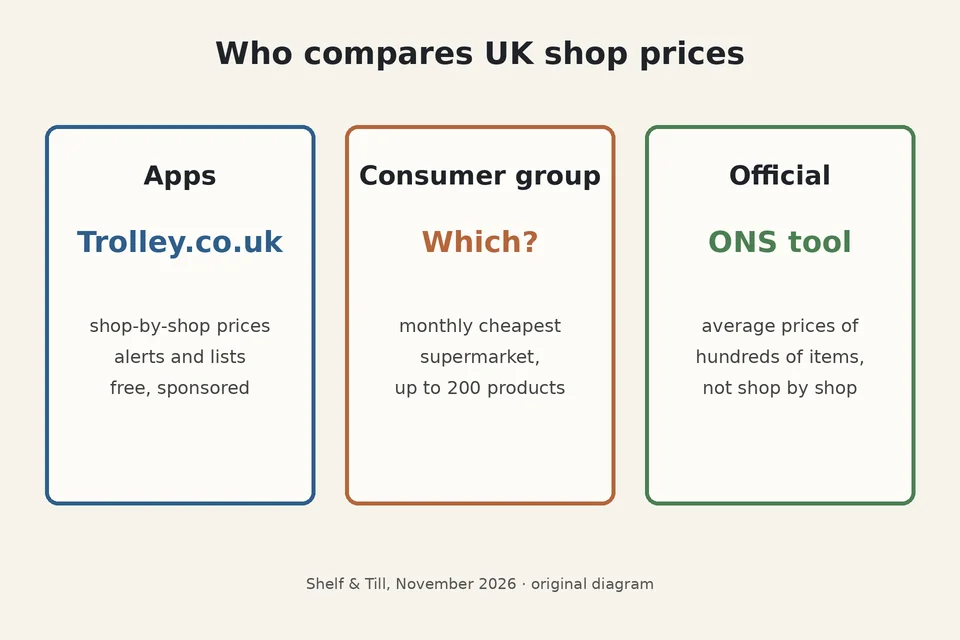
Who compares UK supermarket prices
An app for shop-by-shop prices, a monthly league table, an official average and the data firms behind them: what each comparison can tell you.
 Labels & units
How to read a unit price
The small number on the shelf label, its five traps, and the rules in force since April 2026.